

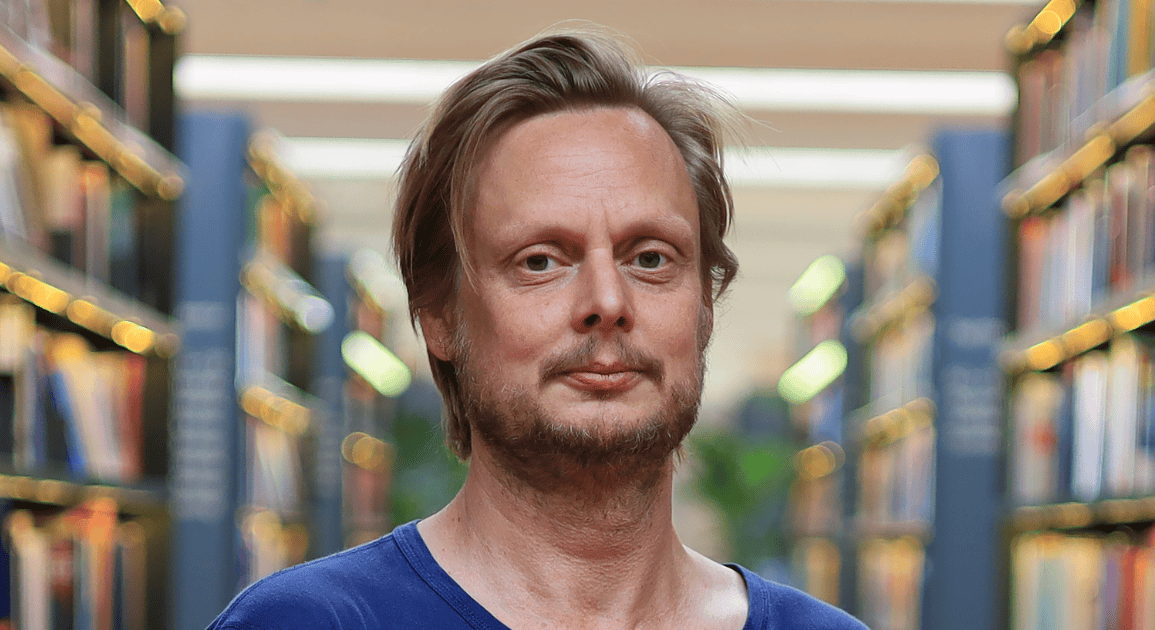
Uncertainty is often seen as something to overcome, but Niels Offenberg from Albertslund Bibliotek sees it as an essential part of working with art and culture. For him, embracing uncertainty creates space for hope, action and the possibility of imagining a different future.
At Building Green CPH on 28–29 October, Niels Offenberg joins the debate “Rebuilding hope through culture and collaboration”. We spoke with him about the role of culture, the importance of communities and why the future should never be seen as fixed.
What does this year’s theme, “Navigating Uncertainty – Hope Through Action”, mean to you and your work?
– A lot! I think the triangle Uncertainty/ Hope/ Action (and you could despair or paralyzed as the negative pairs we want to escape or move beyond) is precisely where my work is situated. In my field of culture uncertainty has always been a key factor or premise for working with art and culture – as a positive feature, but mostly uncertainty has been tried to be dissolved or eliminated, whenever culture is brought into play; that be in teaching, institutions, actions or whatever. Uncertainty is not seen as a quality but something that should be avoided – and in that process the force or strength of culture/ art is lost. Reduced to something it is not. My experience is that whenever the uncertainty is eliminated (which it cannot be by the way) it is reduced to fixed answers about the future and future solutions, hope and action is eliminated too. Then the future is certain and fixed – when doesn’t leave and room for things to be different and thus reasons to hope or act. All this is banal but in reality the reduction and unwillingness to try to be in uncertainty is overwhelming. So within my work I try to stay in this uncertainty – where art and culture have an exemplary advantage – and move it into other areas, where we need it – to act. Politics, economy, environment etc..
Where do you see the greatest opportunities to act differently precisely because the world and the industry have become more uncertain?
– I think it is walking a thin line; the world is uncertain (but it always was – we just thought it was different), but for many the answer is not more certainty and fixed answers. So the opportunity is that to stay in the unknown and again – banal – let it sink in, that things can always be different – on all levels. So the real opportunity here is to speak against the powers (in plural), that maintain that the future is fixed. It seems abstract, but because I think you can work on this on many levels, it is not. From classrooms to the political powers.
What does it take to turn hope into concrete action?
– Hope needs a space to work in – a place where you feel the immediate actions take shape and actually change something – and then it need communities. Hope turned into actions is for me that you can turn your individual hope into something in common actions – so you need other people, where you share the hope (and in all forms) and do something. And often in a community that is tangible and often local.
What role can culture and community play when an area needs to be rebuilt after a crisis?
– The above – to create spaces where you actually can see that the world or future is plural and not fixed – and try it out. But not alone – together with others. And the art/ culture functions also as communications and bridges for the different types of hopes. In culture they can be manifested in multiple ways (and not just the written form – the form of power, which leaves all behind who don’t master or get this form). And then the community is the place/ space where you feel the real change, because you need to do it or feel it together with others to feel the impact and act. The crisis is not yours – it is the communities. Otherwise you’ll feel lost and left alone (“it is just you”!) without any power to act. Paralyzed.
What is the most important point you would like to bring to the debate “Rebuilding hope through culture and collaboration”?
– “All can always be different”
What do you hope the participants will take away from the debate?
– Because I represent the cultural side – or this type of institution – I hope the debate will find ways, that that culture and art can participate and be relevant. Ways the others sectors didn’t think about – in terms of being able to embrace uncertainty.
Rebuilding hope through culture and collaboration at Building Green CPH
At Building Green CPH on 28–29 October at Lokomotivværkstedet in Copenhagen, the Royal Danish Academy facilitates the debate “Rebuilding hope through culture and collaboration”.
The debate explores how communities can rebuild during times of crisis, the role of culture, art and collaboration, and why the rebuilding process can be just as important as the physical result. Drawing on experiences from India, Denmark and Ukraine, the panellists discuss how local communities can help create hope and new possibilities for the future.
