

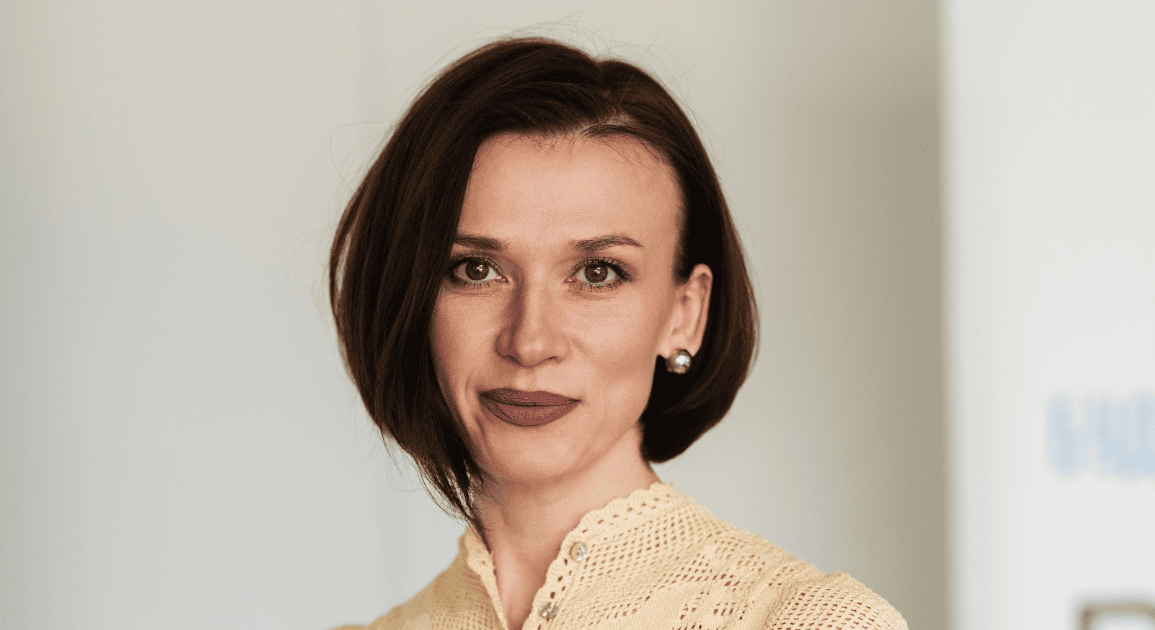
In Ukraine, rebuilding is about more than restoring buildings. Through the Libraries for All project, Svitlana Pyvovarova Operations Manager, works as part of a team alongside Nataliia Prysukhina Programme Director, and Mykola Kocherhan Project Lead, to transform existing libraries into inclusive spaces that respond to the changing needs of communities affected by war.
At Building Green CPH on 28–29 October, Svitlana Pyvovarova, Program Manager for Libraries for All: Inclusive Spaces for Socialization and Support for Veterans, joins the debate ‘Rebuilding hope through culture and collaboration’, sharing experiences from Ukraine and exploring how international cooperation, universal design and community involvement can shape the rebuilding process.
What does this year’s theme, “Navigating Uncertainty – Hope Through Action”, mean to you and your work?
For me, hope is not a feeling we wait for. In Ukraine, hope has to be built through action.
Working on Libraries for All has shown me that we cannot wait for a moment when the situation becomes stable enough to plan the “right” future. We are working with existing library buildings, communities affected by war, changing needs and limited resources. We have to make decisions today, while knowing that some of the conditions may change tomorrow.
This changes the way we work. We focus less on creating a perfect final solution and more on creating solutions that are useful, adaptable and possible to implement.
One of the most important lessons from our project is that uncertainty does not mean that we should stop planning. It means we need to plan differently – with more flexibility, more dialogue with users and a much stronger connection between design decisions and real human needs.
Where do you see the greatest opportunities to act differently precisely because the world and the industry have become more uncertain?
I see a major opportunity in reconsidering what we mean by “rebuilding”.
In Ukraine, we have an enormous amount of existing buildings and infrastructure. At the same time, communities have changed dramatically because of displacement, loss, injuries and the return of veterans. Simply rebuilding what was there before is often not enough.
Libraries are a good example. We are not trying to create beautiful libraries as isolated architectural objects. We are asking: what does this community need this building to do now?
This leads to a different design process. We need architects to work much closer with librarians, municipalities and users, and to test assumptions before investing heavily in construction.
Our experience in Denmark reinforced this for us. We saw that many of the strongest solutions are not necessarily about expensive technology or spectacular architecture. They are about understanding how people actually use a place – where they sit, how they move, where they feel comfortable, when they need privacy and when they want interaction.
For Ukraine, this is particularly important because resources are limited. We cannot afford to build things that look good on paper but do not work for people.
What does it take to turn hope into concrete action?
The first thing is to move from intention to responsibility.
It is easy to say that we want inclusive, human-centred and sustainable reconstruction. The difficult part is deciding who will do what, with which resources, by when, and how we will know whether it actually works.
In Libraries for All, we therefore work with real buildings and real architectural teams rather than treating universal design only as a theoretical topic. The training in Denmark was designed around this principle: learn from practice, visit completed projects, speak to the people who operate them, and then bring that knowledge back to our own cases.
Another important lesson is that action does not always start with construction. Sometimes the most valuable action is changing a decision-making process.
For example, asking users about their experience before designing a space can reveal something that is invisible in a conventional architectural brief. A person may technically be able to enter a building, but still avoid using it because the environment is overwhelming, confusing or simply does not make them feel welcome.
For us, turning hope into action means making these human realities part of professional decision-making.
What role can culture and community play when an area needs to be rebuilt after a crisis?
Culture and community are not an “extra” that comes after the physical reconstruction. They are part of the infrastructure of recovery.
This is one of the reasons we chose libraries.
A library can provide books and information, but it can also become a place where people meet, spend time safely, learn, access services, work, participate in community life or simply be around other people without having to explain themselves.
This is particularly important for veterans and people with disabilities. Inclusion is not only about whether a person can physically enter a building. It is also about whether they feel that the space was designed with them in mind.
There is also an important psychological dimension. After a crisis, people often lose a sense of continuity and belonging. Public cultural spaces can help restore this connection with the community.
But there is a nuance we have learned: we should not decide for communities what they need.
One of the risks in reconstruction is that professionals arrive with good intentions and a ready-made solution. Even an excellent international example can fail if it is simply copied into a different social and cultural context.
The role of architects and international partners should therefore be to bring knowledge, methods and experience – but leave enough space for the local community to shape the result.
What is the most important point you would like to bring to the debate “Rebuilding hope through culture and collaboration”?
For me, it is this:
The process of rebuilding is itself part of what we are building.
If we rebuild a library but exclude the people who will use it from the process, we may create a new building without creating a stronger community.
In Ukraine, we need international expertise, and we are extremely grateful for it. But international cooperation works best when it strengthens local capacity rather than replacing it.
Our experience with the Danish partners has been valuable precisely because it was not simply about receiving answers. Our architects were able to see how Danish professionals think, ask questions, challenge their own assumptions and then return to their Ukrainian projects with new tools.
I also think we need to accept that collaboration is not always comfortable. Different countries, professions and communities have different priorities and different ways of working. Good collaboration creates a space where these differences can be discussed rather than hidden.
For me, successful reconstruction is therefore not only about what we build. It is also about who learns, who participates, who makes decisions and what capacity remains in the community after the project is finished.
What do you hope the participants will take away from the debate?
I hope they leave with a slightly different understanding of what “rebuilding” means.
Not only rebuilding buildings, but rebuilding relationships, trust, local capacity and a sense of belonging.
And I hope they understand that uncertainty should not become an excuse for postponing action. At the same time, action does not mean rushing into construction.
Sometimes the most responsible action is to stop, listen, observe and ask better questions before making a decision.
From our experience in Ukraine, I would also like participants to remember that universal design is not a checklist added to a project at the end. It is a way of thinking about people from the very beginning.
And finally, I hope our experience demonstrates that international collaboration can create something much more valuable than a transfer of “best practices”. It can create a two-way exchange, where Ukrainian realities also challenge Danish and international professionals to rethink their own assumptions about resilience, inclusion and reconstruction.
Rebuilding hope through culture and collaboration at Building Green CPH
At Building Green CPH on 28–29 October at Lokomotivværkstedet in Copenhagen, the Royal Danish Academy facilitates the debate “Rebuilding hope through culture and collaboration”.
The debate explores how communities can rebuild during times of crisis, the role of culture, art and collaboration, and why the rebuilding process can be just as important as the physical result. Drawing on experiences from India, Denmark and Ukraine, the panellists discuss how local communities can help create hope and new possibilities for the future.
